
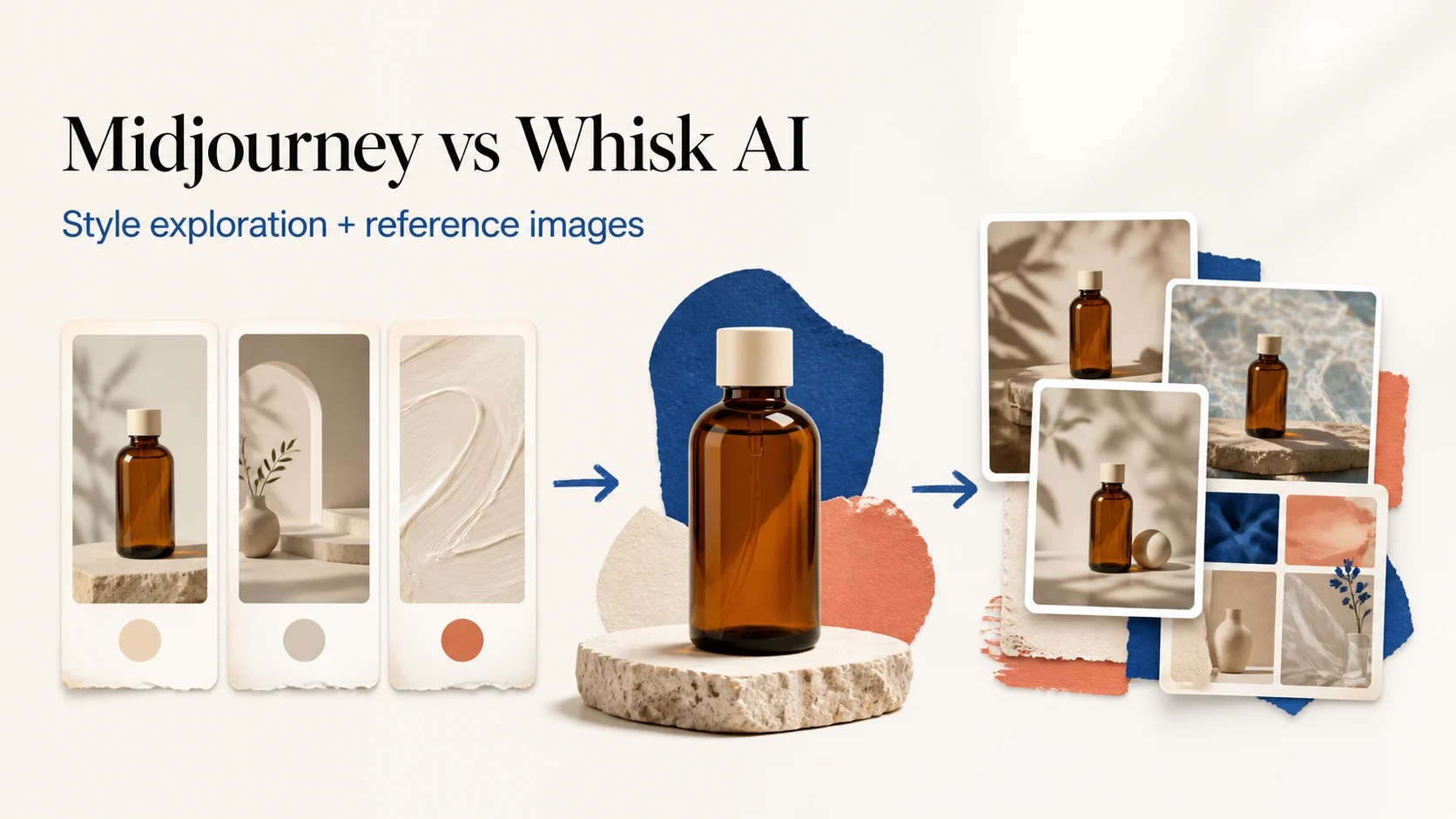
Style exploration gets harder when the reference image has to do too many jobs. A product photo may need to keep the bottle recognizable, borrow the light from another image, and move into a new setting. A moodboard may need to establish a visual world without carrying any of its objects into the result.
Midjourney and Whisk AI solve that brief from different directions. Midjourney gives you several reference types, style controls, moodboards, and a visual library for finding new directions. Whisk AI separates the brief into Subject, Scene, and Style references, then lets you explore those inputs inside a model-switching image workspace.
This is a workflow comparison, not a claim that one system produces the best image in every case. The useful choice depends on what must stay stable, how open the style search is, and how much work the next revision will require.
The short answer
| Creative job | Stronger starting point | Why | Main check before approval |
|---|---|---|---|
| Keep a known subject while testing several settings | Whisk AI | Subject, Scene, and Style references have separate roles | Product silhouette, materials, and small details |
| Search for a distinctive visual language | Midjourney | Style References, Moodboards, Style Explorer, and stylize controls support broad art direction | Whether the style overwhelms the subject |
| Combine a subject reference with an intentional look | Either, based on the next edit | Whisk makes the input roles explicit; Midjourney layers image, style, and Omni influence | Which system lets you change one variable without rebuilding the brief |
| Prepare a final catalog or regulated product image | Approved source photography | Generated pixels can change packaging, claims, or measurements | Exact product truth and compliance |
Whisk AI is the better first stop when the brief already has a subject and a scene. Midjourney is the better first stop when the brief is still searching for a visual language. Neither reference system should be treated as a pixel-locked replacement for approved product material.
What style exploration actually measures
The first image is only one part of the decision. A good style exploration process should answer four questions:
- What does the reference control? Subject identity, composition, color, texture, or the overall mood?
- What can change without collateral drift? A background, a crop, a lighting direction, or the whole visual treatment?
- Can the team repeat the direction? A named reference role, a saved moodboard, a style code, or a recorded prompt should lead to another useful pass.
- What does the next edit cost? Count the new references, prompt changes, generation time, credits or GPU time, and review work.
The last question separates a fun image generator from a usable creative process. If every change requires a new prompt and a new pile of references, a beautiful first result may still slow down the campaign.
Whisk AI: give each reference one job
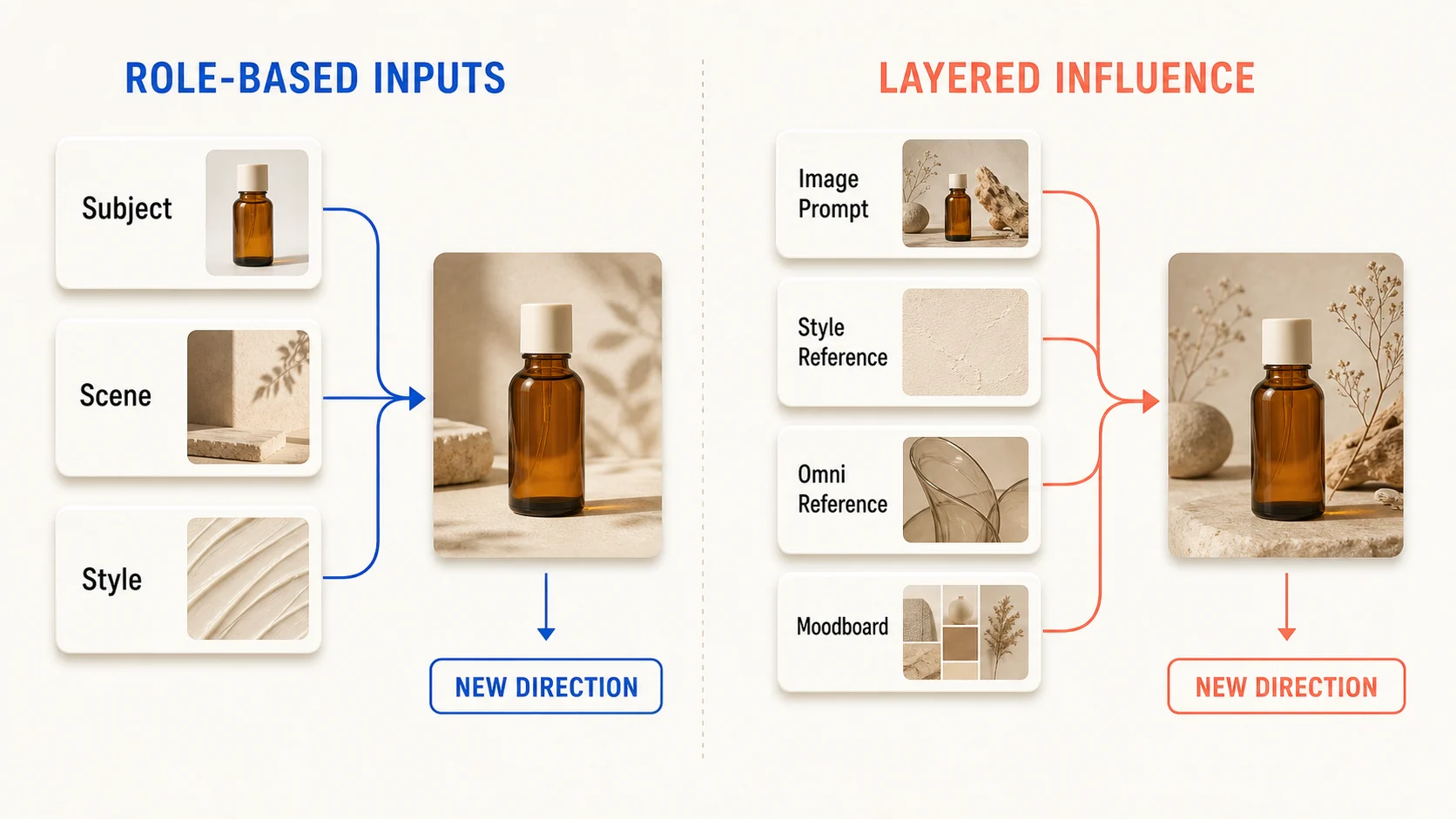
Whisk AI's image workspace turns the reference-led brief into three optional one-image slots:
- Subject carries the product, person, or object that should remain recognizable.
- Scene carries the location, props, scale, and environmental arrangement.
- Style carries the palette, texture, lighting, medium, or visual treatment.
You can add a text prompt for decisions that the images do not state clearly, such as a landscape crop, negative space for copy, camera distance, or an audience. The current workspace maps the three roles to an image-to-image model input and keeps each role limited to one image, so the brief stays inspectable before generation.
That structure works well for a product team. Keep the same bottle in Subject, switch the Scene from a studio surface to a morning kitchen, and change Style only when the campaign needs a new visual language. The Whisk AI workspace also exposes a current image model catalog, so you can change the generation model without moving the reference brief into another application.
The tradeoff is interpretation. Whisk AI uses the references as creative guidance, not as a compositing instruction. A label, cap, pattern, or exact color can drift. The AI product photography guide uses the same separation to show where a creative draft should give way to product review.
| Whisk AI control | Useful for | Review before approval |
|---|---|---|
| Subject slot | Holding a known object or person steady while the scene changes | Shape, proportions, surface, and identity details |
| Scene slot | Testing locations, props, lighting context, and camera distance | Whether the environment changes the subject's scale or material |
| Style slot | Comparing color, texture, medium, or art direction | Whether the style reference adds a decision instead of generic decoration |
| Text prompt | Adding crop, copy space, audience, and exclusions | Whether the prompt asks for a bounded change |
| Model selector and credit estimate | Comparing model behavior and the cost of another pass | Output ratio, resolution, and the next revision budget |
Choose Whisk AI when the creative team thinks in terms of "keep this, change that." It gives each input a place in the brief and keeps the next question close to the current image.
Midjourney: layer style and subject influence
Midjourney gives a reference image different jobs through separate controls. An Image Prompt can influence content, composition, and colors. A Style Reference carries the visual feel of an image, including colors, textures, lighting, and medium, without asking the result to copy the source objects. An Omni Reference can bring a person or object from one image into a new creation.
These controls can work together, but they do not have the same boundary. Image Prompts need a text prompt to describe the result. Style References need a text prompt and support a style weight from 0 to 1000. Omni Reference accepts one image, runs with version 7, and costs more GPU time than a regular version 7 image. Omni outputs also have limits around older editing features such as Vary Region, Pan, and Zoom Out.
Midjourney also has two useful style-discovery surfaces. Moodboards collect selected images into a reusable aesthetic profile with a code. The Style Explorer lets you browse and search style codes, then save the ones worth testing. Those features make Midjourney a strong place to explore a visual world before you know which single reference image should lead the brief.
| Midjourney reference or control | Strongest use | Main constraint |
|---|---|---|
| Image Prompt | Content, composition, and color guidance from one or more images | It inspires a new image rather than copying the source exactly |
| Style Reference | A repeatable look based on color, medium, texture, or lighting | It does not carry the source objects or people into the result |
| Omni Reference | Bringing one known object, person, or character into a new scene | One image only, version 7, extra GPU time, and editing limits |
| Moodboard | Broad aesthetic exploration across a curated image set | Moodboard style is less specific than one focused Style Reference |
| Style Explorer and style codes | Finding and reusing visual directions | A code can define a look without preserving a specific product |
| Stylize and reference weights | Balancing literal prompt behavior and artistic interpretation | Higher influence can compete with subject fidelity |
Midjourney is a good choice when style discovery is the main job. It asks for more decisions about which reference type to use, but those decisions also give an experienced art director more room to steer a visual system.
Choose by creative job
Keep one subject across several scenes
Start with Whisk AI. Put a clean source in Subject, define the setting in Scene, and add Style only when it answers a separate creative question. Make one change per branch. If the product drifts, simplify the scene or style input before adding more prompt detail.
Search for a visual language from a loose brief
Start with Midjourney. Use a Moodboard when the direction needs several images to establish a world. Use a Style Reference when one image captures the look. Use Style Explorer when the team needs more possibilities before it commits to a reference set.
Preserve a person, character, or object inside a new treatment
Use the system that matches the revision boundary. Whisk's Subject slot keeps the role visible and can be paired with a separate Scene and Style. Midjourney's Omni Reference gives a dedicated object or character control, but its version and editing constraints need to fit the project. Check the details that matter, since logos, small marks, and intricate features can change in either system.
Make a final product record
Use approved photography or a reviewed source asset. These systems can explore the background, crop, light, or campaign atmosphere. They should not define the final label, dimensions, ingredients, legal copy, or regulated claim.
Run a fair reference test
Use one neutral brief instead of letting each system solve a different problem:
Place an unbranded amber skincare bottle on pale limestone. Explore a quiet morning campaign direction with soft side light, a warm off-white background, and clear negative space on the right for copy.
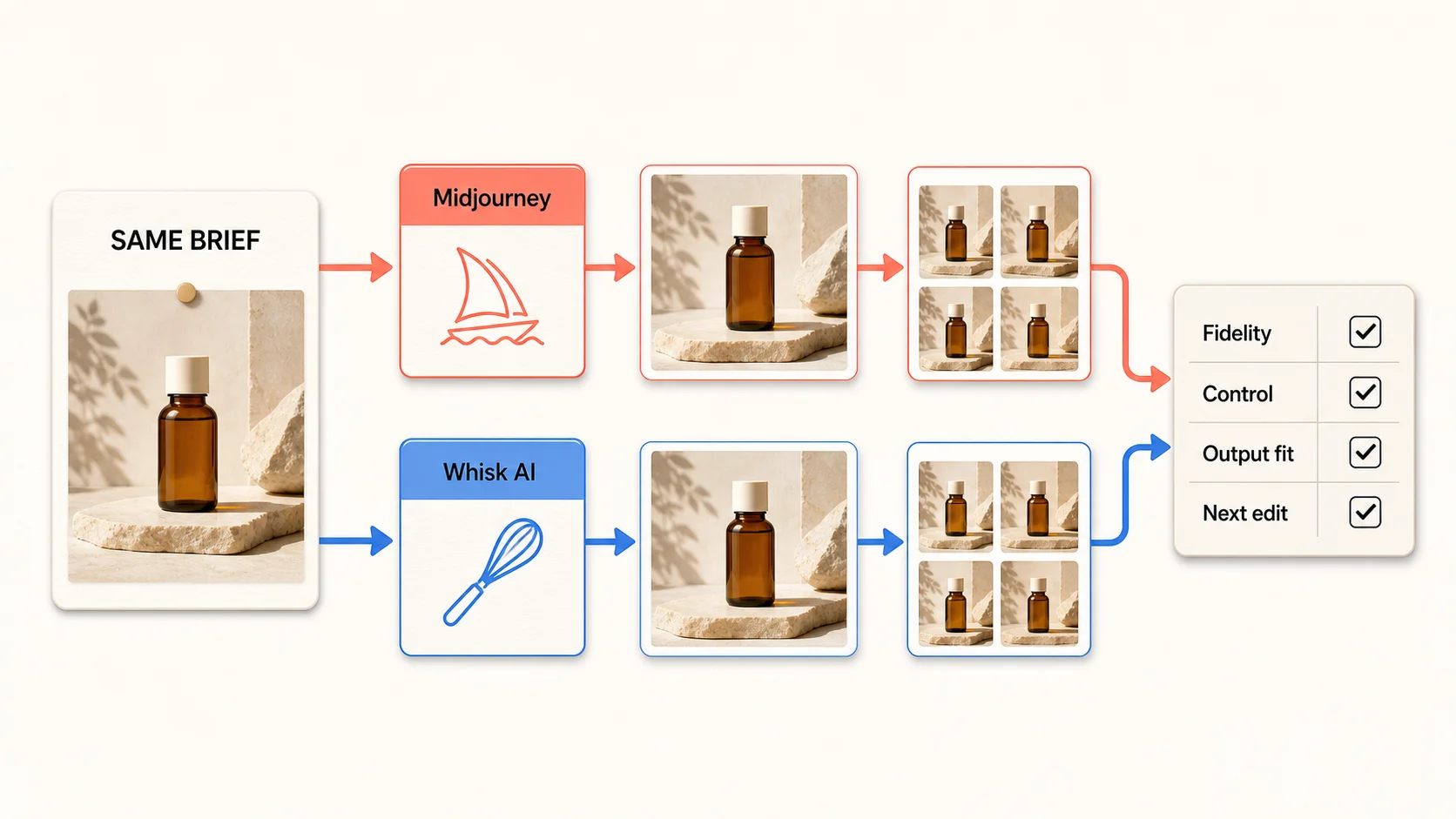
Keep the source image, aspect ratio, review size, and number of attempts constant. Run the comparison in five passes:
- Generate one first direction in each system.
- Change only the scene or lighting in the second pass.
- Test a style change while keeping the product description and crop stable.
- Make one bounded correction, such as moving the bottle or restoring open copy space.
- Record the inputs, settings, usage, failed detail, and next requested edit.
Do not compare a polished branch from one system with a first attempt from the other. Give both systems one chance to correct their weakest decision.
| Review dimension | Pass condition | Revise when |
|---|---|---|
| Fidelity | The subject keeps the shape, material, and details that buyers need to recognize | The reference-led change alters the product without permission |
| Style control | The chosen look is visible and supports the campaign idea | The result falls back to a generic aesthetic or overwhelms the subject |
| Output fit | Ratio, resolution, focal point, and copy space match the channel | A second composition is required before the image can move forward |
| Repeatability | Another teammate can find the reference set and recreate the direction | The winning result depends on an undocumented prompt or setting |
| Next edit | The next change has one clear target and a bounded input set | The whole brief must be rebuilt to fix one defect |
This scorecard turns "I like this" into a production decision. It also exposes the different costs. Whisk AI may make a Scene revision easy because the input role remains visible. Midjourney may make a style search more rewarding because a moodboard or style code can carry the look across new prompts. The better choice is the one that reduces the hardest repeated decision.
Bottom line
Choose Whisk AI for reference-led composition with a known subject, a defined scene, and a small set of deliberate style experiments. Choose Midjourney for open-ended style exploration, reusable moodboards, style-code discovery, and layered reference influence.
The two systems can also sit at different points in one creative process. Use Midjourney to discover a visual language, then use a role-based brief in Whisk AI when the team needs to place a known subject into several controlled scenes. Keep the approved product source as the authority, record the winning references, and judge the next edit before you judge the first image.
Frequently asked questions
Which is better for style exploration, Midjourney or Whisk AI?
Midjourney is the stronger starting point for broad style discovery because Moodboards and Style Explorer are designed to help you search for a visual language. Whisk AI is the stronger starting point when you already have a style reference and want to compare it with a known subject and scene.
Can Whisk AI and Midjourney use the same reference images?
Yes. Use the same source image, scene reference, and style reference where each system accepts them. Keep the review criteria fixed, then record how each system interprets the references instead of comparing only the final color or mood.
Does Midjourney preserve a product exactly with an Omni Reference?
No. Omni Reference can carry an object into a new creation, but small marks, logos, and intricate details may change. Use approved product material when those details are non-negotiable.
Does Whisk AI use Midjourney models?
No. Whisk AI exposes its own current image model catalog. Midjourney is a separate comparison option. Compare the reference workflow and revision cost rather than assuming that one workspace hosts the other service's models.
Should I choose by image quality alone?
No. Compare the first image, the next edit, the output fit, and the time needed for review. A direction that needs fewer corrective passes can be more useful than a more dramatic first result.